
Do wet outer gloves mean they are leaking?
Water repellency, waterproofness and dry-feeling comfort are different. Here is how brands can specify and evaluate waterproof knitted gloves.
PUBLISHED 2026-09-28
Rain beads rolling off a glove make a compelling demonstration. But if the knit darkens and starts absorbing water, has the glove stopped being waterproof? Not necessarily: a wet outer fabric alone does not prove that rain has passed through the waterproof layer.
For brands developing waterproof knitted gloves, evaluation should cover surface wetting, material resistance to water penetration and the performance of the finished glove in its intended use.
Water repellency and waterproofness have different jobs
A water-repellent finish helps prevent water from spreading across and wetting the outer textile. A waterproof membrane within the construction provides a barrier to liquid water. When surface repellency declines, the outer knit may absorb water while an intact membrane continues to resist penetration.
GORE-TEX’s DWR guidance makes the same distinction: saturated outer fabric can feel cold and clammy even while the membrane remains waterproof. This source explains the distinction; it does not imply that Evarwin products use GORE-TEX materials.
Reading the diagram
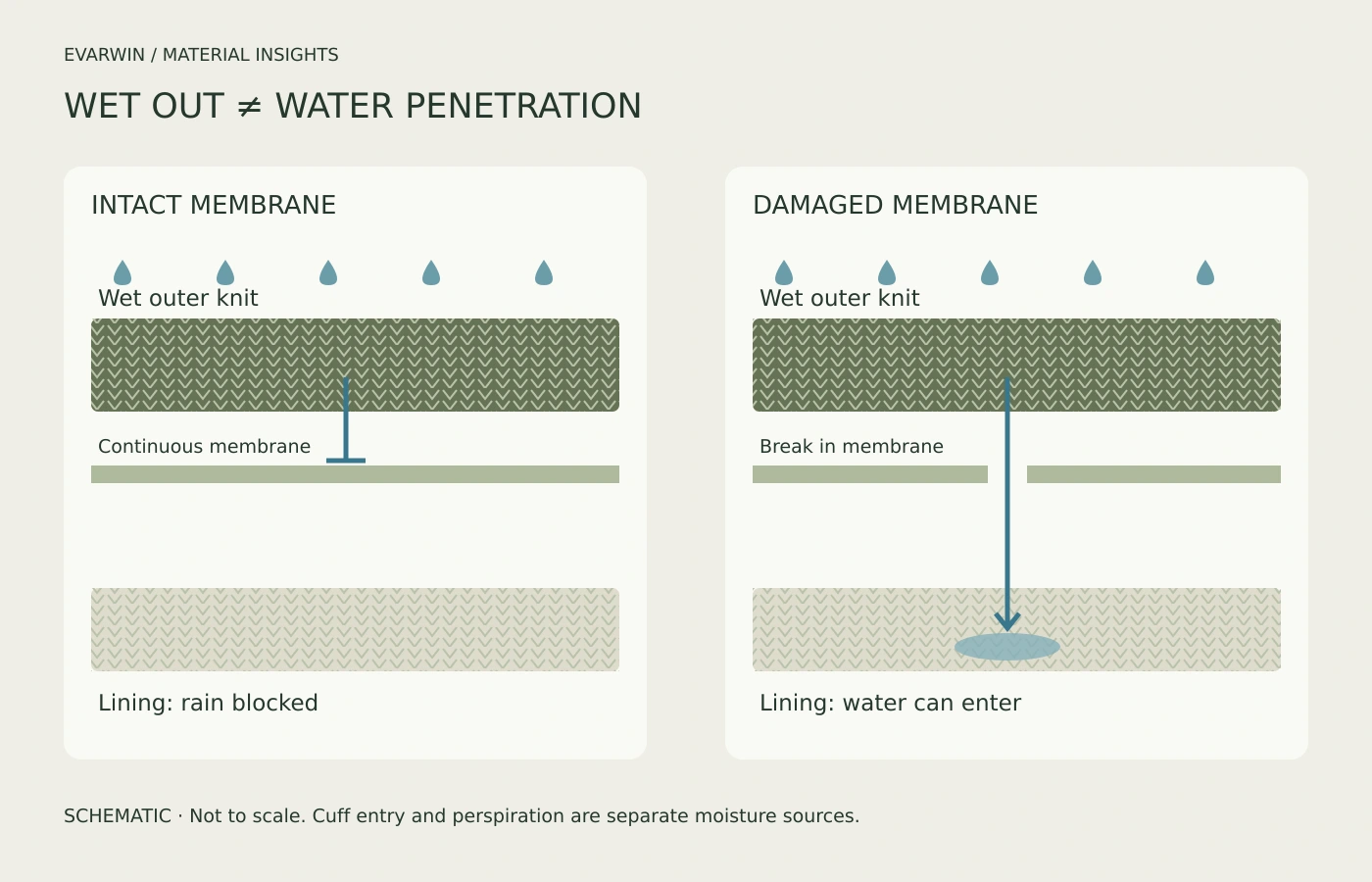
The left section shows a wet outer knit above an intact, continuous membrane: external rain has not penetrated to the lining. The right shows a break in the membrane through which water may pass. This is a schematic comparison, not a test result or a drawing to scale.
The diagram isolates water crossing the membrane. Water entering through the cuff and moisture from the wearer’s hands can still make the inside damp even when the membrane is intact. Identify the moisture source before deciding whether to change the material, construction or wearing arrangement.
Water beading cannot replace waterproof testing
ISO 4920 is a spray test for resistance to surface wetting. Its scope explicitly states that it does not measure water penetration and is not intended to predict resistance to rain penetration. ISO 811 uses hydrostatic pressure to assess a fabric’s resistance to water penetration. These methods answer different questions and cannot substitute for each other.
A finished-glove procedure should separately define water exposure, duration, movement and acceptance criteria for the intended use. A fabric report alone does not establish finished-glove performance in every situation.
Three levels to check during development
1. Material: Is the tested specimen a membrane alone, a laminate or the same construction planned for production? Review the outer knit, membrane and lining alongside feel, stretch and fit. Comparisons only make sense when the tested construction is known.
2. Finished product: Agree on the exposed area, contact time, movements and assessment method. Record cuff entry separately from leakage through the waterproof construction: the wearer may feel similar dampness, but the corrective actions differ.
3. After use: New-product testing is one stage. Depending on the application, agree on evaluation after washing, repeated flexing or abrasion. Everyday commuting, wet-weather cycling and prolonged outdoor activity may require different conditions.
Four questions for your supplier
What was tested: a film, a laminate or a complete glove? Which method, conditions and acceptance criteria were used? Was the specimen new or tested after washing or simulated use? How will production be checked against the approved sample?
Putting those answers into the development specification gives sampling, testing and manufacturing a common basis and helps keep product claims aligned with evidence.
Start with the intended use
Evarwin develops and manufactures waterproof knitted gloves. Begin with your target market, activity, grip requirements, preferred feel and waterproof performance needs, then define materials, construction and acceptance criteria together. Planning a waterproof glove range? Share your brief with Evarwin to discuss sampling and development.
← ALL INSIGHTSPut the technical guidance into practice.
Explore the construction, testing and development decisions behind your specification.
Your next product starts here.
Bring your brief. Let’s work through the possibilities.